Brazil 1-1 Morocco: Vinicius Equalises, Hakimi Influences, Group C Opens 50/50
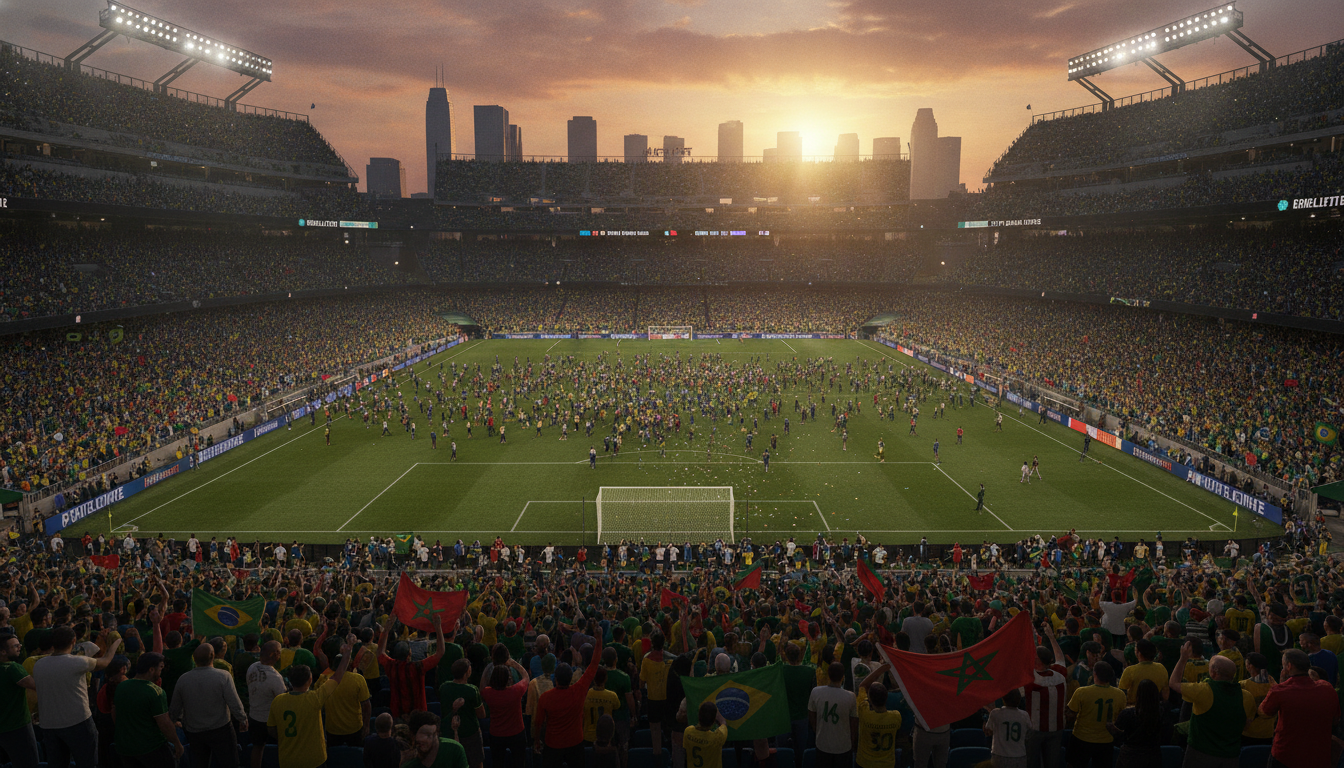
The 2026 FIFA World Cup delivered an early narrative twist in Group C as Brazil and Morocco played out a compelling 1-1 draw at MetLife Stadium on Saturday, 13 June. This result, featuring an early Moroccan lead through Ismael Saibari and a characteristic Vinicius Júnior equaliser, immediately casts a shadow of uncertainty over Brazil’s campaign and elevates Morocco’s credentials. For bettors and analysts, the group stage now appears far more open, moving the needle closer to a 50/50 proposition for Brazil’s top spot than initially anticipated.
The Narrative Unfolds: Early Dominance and Equal Response
The match, Brazil’s Group C opener, commenced with a surprising display of control from Walid Regragui’s Moroccan side. From the outset, the Atlas Lions demonstrated a tactical discipline and assertive pressing game that belied Brazil’s pre-tournament favorites tag. This sustained pressure culminated in the 21st minute when Ismael Saibari found the back of the net, putting Morocco ahead. Saibari’s goal was not merely a flash in the pan; it was the product of a period where Morocco dictated the tempo and largely stifled Brazil’s renowned attacking rhythm. The early goal electrified the atmosphere at MetLife Stadium, signaling to the global audience that Morocco, building on their 2022 semi-finalist heroics, were not content to merely participate.
Morocco’s confidence continued to build, with key figures orchestrating their attacks. Achraf Hakimi, a player whose influence is often pivotal for Regragui’s system, was a constant threat. His ability to ‘stroll through the Brazilian midfield’ on several occasions highlighted a concerning porosity in Brazil’s central defensive structure. A clear opportunity arose for Hakimi in the 27th minute, just six minutes after Saibari’s opener, when he unleashed a shot from the edge of the area. While the effort ultimately missed the target, the sequence itself was a stark illustration of Morocco’s attacking intent and their capacity to penetrate Brazil’s defensive lines. This period of Moroccan dominance laid down a significant marker, challenging the prevailing wisdom about the group’s hierarchy.
However, Brazil, for all their early struggles, possess individual brilliance capable of altering the complexion of any match. The equalizer arrived, as it often does, from a moment of pure, unadulterated individual quality from Vinicius Júnior. Picking up a pass from Guimarães on the left wing, Vinicius executed a move that has become a signature of his game: a sharp cut inside, followed by an unstoppable shot into the top corner of the net. The precision and power of the strike left Moroccan goalkeeper Yassine Bounou with no chance. Bounou, who made the high-profile switch from Sevilla to Al Hilal, had otherwise been solid, but Vinicius’s finish was simply beyond saving. This goal, a classic example of Brazilian attacking flair, not only brought Brazil level but also provided a crucial psychological lift, stemming the tide of Moroccan momentum and ensuring Brazil salvaged a point from a challenging opening encounter.
Ancelotti’s Brazil: Questions Amidst Absences
The performance at MetLife Stadium raised pertinent questions about Carlo Ancelotti’s Brazil, particularly concerning their tactical cohesion and overall readiness. Ancelotti, Brazil’s first foreign coach since 1965, inherited a squad brimming with talent but also facing significant pressure to deliver a World Cup title. The observation that Brazil were “second-best at times” is a critical assessment for a team with outright odds of approximately +800 pre-tournament. This suggests that the tactical blueprint, or its execution, was not consistently effective against a well-drilled Moroccan side.
A significant contributing factor to Brazil’s uneven display was undoubtedly the absence of several key players. The squad entered the tournament without Rodrygo, who is sidelined with a severe ACL and meniscus injury, ruling the Real Madrid forward out of contention. Rodrygo’s dynamism, goal threat, and versatility across the attacking third are substantial losses that force Ancelotti to reconfigure his offensive options. Similarly, the absence of Eder Militão, recuperating from a hamstring injury, weakened Brazil’s defensive spine. Militão’s presence provides crucial aerial dominance, recovery pace, and a physical edge that was noticeably lacking at certain junctures against Morocco’s robust attack. The third notable absence was Vanderson, the Monaco full-back, whose defensive solidity and attacking contributions from wide areas would have offered Ancelotti another valuable option.
These absences collectively created voids in critical areas of the pitch, forcing Ancelotti to rely on alternative selections and potentially adjust his preferred tactical schemes. The need to integrate new partnerships and compensate for the specific skill sets of the injured players likely contributed to the periods of disjointed play and defensive vulnerability that Morocco exploited. Furthermore, the presence of Neymar (Santos) in the 26-man squad added another layer of intrigue. While his inclusion signals his potential availability, the match report did not confirm game-time for the veteran forward. His role, or lack thereof, in the Group C opener, further highlights the transitional phase Brazil finds itself in, balancing established stars with emerging talents and adapting to unforeseen personnel challenges.
Regragui’s Morocco: A Blueprint for Progress
Walid Regragui’s Morocco delivered a performance that reaffirmed their status as genuine contenders, not just in Group C, but potentially deeper into the tournament. Their controlled display against Brazil was a testament to the tactical acumen of Regragui, who famously led the Atlas Lions to the semi-finals in 2022. That historic achievement was built on a foundation of defensive solidity, midfield tenacity, and opportunistic attacking, principles that were clearly evident at MetLife Stadium.
The statement that ‘Morocco controlled large parts of their Group C opener’ is crucial. This control was not merely passive possession; it was a proactive strategy that involved aggressive pressing, intelligent positional play, and a willingness to engage Brazil in the midfield battle. Regragui’s side demonstrated an impressive ability to win back possession and transition quickly, often catching Brazil in vulnerable positions. This collective effort was underpinned by individual brilliance, most notably from Achraf Hakimi. His repeated forays through the Brazilian midfield, culminating in a missed shot at 27 minutes, were not isolated incidents but rather symptomatic of Morocco’s overall confidence and belief in their ability to hurt one of the world’s footballing giants. Hakimi’s influence extends beyond his attacking prowess; his work rate and defensive contributions are integral to Morocco’s well-balanced approach.
In goal, Yassine Bounou provided the reliable presence expected of a goalkeeper who has commanded a significant transfer, moving from Sevilla to Al Hilal. While Vinicius Júnior’s equalizer was unstoppable, Bounou’s overall command of his area, distribution, and calm demeanor instilled confidence in his defense. His experience and big-game temperament are invaluable assets for a team looking to navigate the pressures of a World Cup. Regragui has clearly fostered a resilient and cohesive unit, one that understands its strengths and executes its game plan with unwavering commitment. This performance against Brazil serves as a powerful validation of their strategic approach and signals that Morocco is once again a force to be reckoned with on the global stage, especially for a team with pre-tournament outright odds of approximately +5000.
Group C: The Landscape Shifts
The 1-1 draw between Brazil and Morocco fundamentally reshapes the dynamics of Group C. Both teams now stand on 1 point after matchday 1, a scenario that immediately tightens the race for qualification to the knockout stages. The group also includes Haiti and Scotland, two nations that, while perhaps not carrying the same historical weight as Brazil, will undoubtedly view this result as an opening. Brazil’s failure to secure maximum points against their strongest group opponent means they cannot afford any complacency in their subsequent fixtures.
For Brazil, the path to the top of Group C, which once seemed a foregone conclusion, is now complicated. They will face Haiti and Scotland, matches they will be expected to win, but the pressure will be intensified. Dropping points against either of these teams could prove catastrophic for their aspirations of securing an easier draw in the Round of 16. The psychological impact of not starting with a win, especially against a team they were expected to beat, cannot be understated for a nation that carries the weight of five World Cup titles.
Conversely, for Morocco, securing a point against Brazil is an immense boost. It not only puts them on equal footing with the group favorites but also instills further belief and momentum heading into their matches against Haiti and Scotland. Regragui’s side will now approach these games with the confidence that they can compete with, and even outplay, elite opposition. A strong performance in their remaining group stage matches could see them top the group, potentially setting up a more favorable draw in the knockout phase. The outcome of this opener ensures that every subsequent match in Group C will be keenly contested, with no team able to take progression for granted. The group, initially perceived as having a clear favorite, is now unequivocally open.
Betting Market Dynamics and Tournament Trajectory
The pre-tournament outright odds for Brazil stood at approximately +800, marking them as one of the favorites for the trophy. Morocco, by contrast, were long shots at around +5000. This 1-1 draw, however, will undoubtedly cause a recalibration in the betting markets and the broader perception of both teams’ tournament trajectories. While a single draw in the group stage is far from fatal, especially for a team of Brazil’s caliber, it does introduce an element of doubt that was largely absent prior to the match.
For Brazil, the result might not drastically alter their overall tournament odds, but it will certainly temper expectations and highlight areas of concern for punters. The ‘second-best at times’ assessment suggests that the road to the final will be arduous, requiring significant improvements in cohesion and tactical execution. The absence of key players like Rodrygo and Militão will continue to be factored into future assessments, as their return, or the lack thereof, could significantly impact Brazil’s performance in the latter stages.
For Morocco, the draw is a significant positive. While their outright odds may not shorten dramatically, their perceived chances of progressing from Group C, and potentially making another deep run, will certainly improve. The performance has demonstrated that their 2022 semi-final appearance was no fluke, and they possess the tactical discipline and individual talent to challenge the very best. This result could encourage more speculative betting on Morocco to advance further than their initial odds suggested. Furthermore, the match being played at MetLife Stadium, the very venue set to host the World Cup final on 19 July, adds a layer of symbolic significance. For Morocco, securing a point against Brazil in such an iconic stadium on the opening day of the tournament is a powerful statement of intent, suggesting they are comfortable on the grandest stages.
The opening Group C fixture at MetLife Stadium has delivered an immediate dose of World Cup drama and analytical intrigue. Brazil’s draw with Morocco, while not a disaster, has undeniably complicated their path and illuminated areas for improvement under Carlo Ancelotti. For Walid Regragui’s resilient Morocco, it is a significant validation of their continued ascent in international football, firmly establishing them as a formidable opponent. The group stage for Brazil, Morocco, Haiti, and Scotland is now wide open, promising a captivating series of matches as all four teams vie for progression, making the betting landscape far more nuanced than initial predictions suggested.
Sources: amNewYork — Brazil and Morocco share spoils at MetLife, CBS Sports — Brazil 1-1 Morocco match story, FOX Sports — Brazil vs Morocco final score, Olympics.com — WC 2026 schedule and results
Sources

Related news
France vs Senegal Preview: Mbappé’s First World Cup Match Lands at MetLife
France open their 2026 World Cup campaign against Senegal at MetLife Stadium on Tuesday 16 June.…
Five Days In: Where Matchday 1 Has Left the 2026 World Cup Favourites
Mexico routine, USA emphatic, Germany sensational. But Brazil were second-best for stretches against Morocco, Switzerland could…
Scotland 1-0 Haiti: Scotland’s First World Cup Win Since 1998
Scotland beat Haiti 1-0 at Gillette Stadium in Boston on Sunday 14 June for their first…