Hakimi’s Hamstring Tear: Morocco’s Right-Back Avoids the World Cup Scare — Just
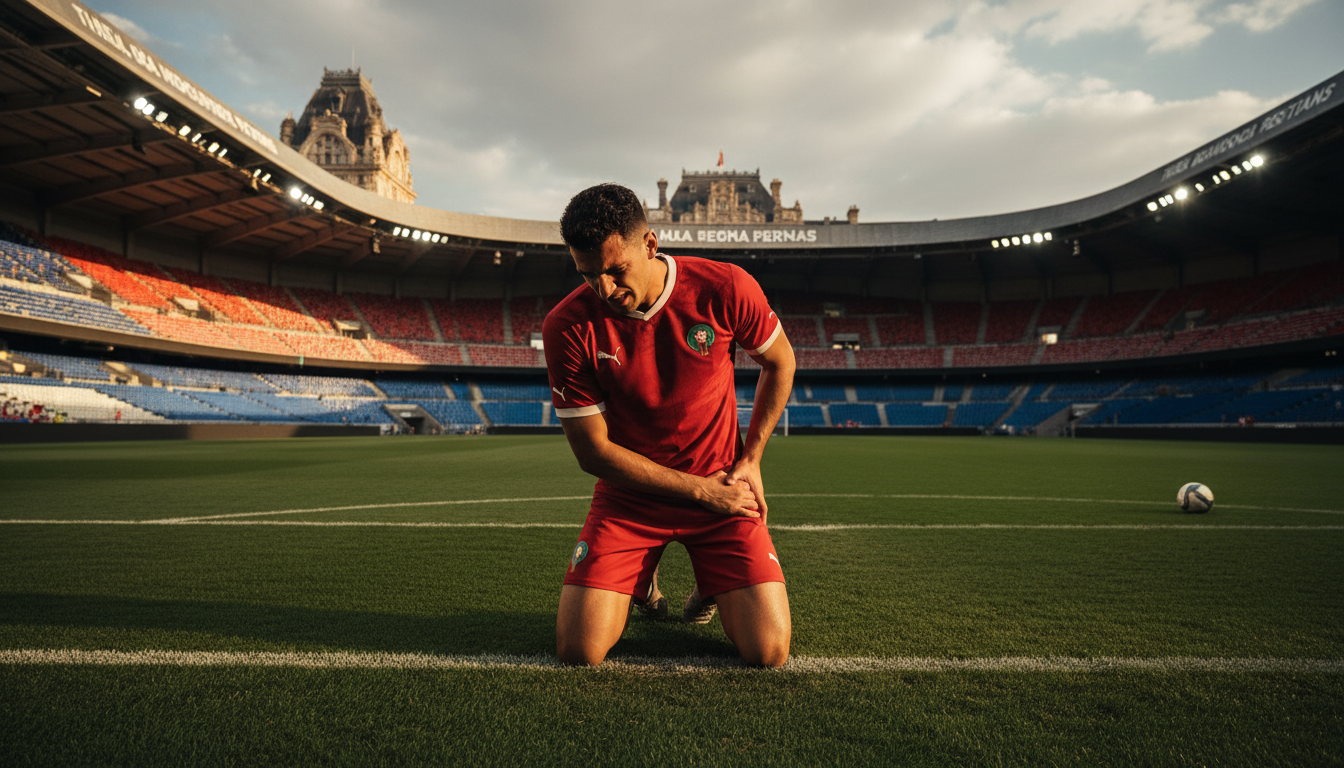
Hakimi’s Hamstring Tear: Morocco’s Right-Back Avoids the World Cup Scare — Just
Achraf Hakimi suffered a hamstring tear in the 88th minute of PSG’s 5-4 first-leg win over Bayern Munich. He misses the Champions League semi-final return — but Morocco’s medical team have signalled he is on track for the 13 June opener against Brazil.
The final minutes of Paris Saint-Germain’s thrilling 5-4 Champions League semi-final first-leg victory over Bayern Munich at Parc des Princes delivered a significant scare for both club and country. In the 88th minute, Achraf Hakimi, PSG’s dynamic right-back, suffered a hamstring tear, an injury that immediately sent ripples of concern through the Moroccan national team camp. The immediate aftermath was fraught with anxiety, as Hakimi, a player of immense importance to his club and an undisputed linchpin for his nation, remained on the field until the final whistle due to PSG having already exhausted their allocation of substitutions. This meant he played through the final moments of a high-intensity European tie with a confirmed muscular injury, a situation far from ideal for recovery timelines. The initial dread, particularly for Morocco, centered on the looming 2026 FIFA World Cup, now less than two months away. The prospect of losing one of their most influential players for the global showpiece was a scenario few associated with the Atlas Lions dared to contemplate. However, subsequent reports and official diagnoses have offered a crucial, albeit cautious, reprieve, indicating that while Hakimi will miss a pivotal club fixture, his participation in Morocco’s World Cup campaign remains on track, a development that has undoubtedly brought a collective sigh of relief from Rabat to Casablanca and beyond.
The Immediate Aftermath and PSG’s Challenge
The diagnosis, swiftly confirmed by Fabrice Hawkins via RMC Sport, specified a hamstring tear in Hakimi’s right thigh. This official confirmation immediately clarified the extent of the injury and its implications for PSG’s immediate future. The most pressing consequence for the French champions is Hakimi’s unavailability for the crucial Champions League semi-final second leg against Bayern Munich, scheduled for 6 May in Germany. PSG travels to Munich holding a slender one-goal aggregate advantage from their 5-4 first-leg triumph, a lead that, while significant, is far from insurmountable against a team of Bayern’s caliber. The absence of Hakimi, a player renowned for his blistering pace, defensive solidity, and attacking thrust down the right flank, will undoubtedly force tactical adjustments from the PSG coaching staff. His ability to stretch opposition defenses and provide a critical outlet in transition is a facet of PSG’s play that will be sorely missed. Should PSG navigate this challenging second leg, the Champions League final awaits at the Puskás Aréna in Budapest on 30 May 2026. While Hakimi’s recovery timeline suggests he would likely be available for a potential final, the immediate focus is on overcoming Bayern without him. Critically, reports also indicate a pragmatic approach from the Moroccan national team’s medical staff, who are not expected to risk Hakimi’s involvement in the second leg, signaling a clear prioritization of his fitness for the World Cup over a potentially premature return to club action. This strategic decision underscores the profound importance of Hakimi to Morocco’s international ambitions, even at the expense of a Champions League semi-final.
Morocco’s World Cup Prospects and Hakimi’s Central Role
The true significance of Hakimi’s injury and subsequent recovery timeline becomes acutely apparent when examining Morocco’s 2026 FIFA World Cup campaign. The Atlas Lions are set to kick off their tournament on 13 June against formidable opponents Brazil at MetLife Stadium. This pivotal match occurs exactly 38 days after PSG’s Champions League second leg in Munich, providing a critical, albeit tight, window for Hakimi’s rehabilitation and return to peak fitness. Hakimi is not merely a squad player for Morocco; he is their first-choice right-back and unequivocally one of their most decisive attacking outlets. His role in the team transcends traditional defensive duties, as he consistently provides width, creativity, and a goal threat from deep positions. His ability to link up with midfielders and forwards, execute incisive overlaps, and deliver dangerous crosses is fundamental to Morocco’s offensive strategy. Morocco finds itself in Group C, alongside Brazil, Haiti, and Scotland, a challenging but navigable group. The Atlas Lions enter the tournament with outright odds of +5000, placing them twelfth on the board and earning them the coveted ‘Dark Horse’ tag among analysts and bettors. This designation is not without merit, especially considering their historic performance at the 2022 Qatar World Cup, where they reached the semi-finals, marking the deepest run by any African nation in tournament history. That unprecedented achievement firmly established Morocco as a significant force on the global stage, and Hakimi was central to that success. His presence, therefore, is not just about individual brilliance but about maintaining the tactical equilibrium and high performance levels that defined their previous World Cup exploits.
Tactical Implications and the Brazil Opener
The projected individual matchup between Achraf Hakimi and Brazil’s Vinícius Júnior was already highlighted as one of the marquee contests of the Brazil opener on 13 June. This head-to-head battle on the right flank, pitting two of the world’s most dynamic wide players against each other, epitomized the high stakes and thrilling potential of Morocco’s opening World Cup fixture. Hakimi’s presence in this encounter is not merely about containing Vinícius Júnior, a formidable task in itself, but also about providing an attacking counter-threat that can push the Brazilian winger back and prevent him from wreaking havoc in Morocco’s defensive third. His absence would necessitate a significant tactical rethink, potentially forcing Morocco to adopt a more conservative approach on that side of the pitch or to deploy a less offensively potent full-back, thereby diminishing their overall attacking potency. The 38-day window between the Bayern second leg and the Brazil match is a tightrope walk for medical and coaching staff. It’s a period that must balance rigorous rehabilitation with the gradual restoration of match fitness, agility, and explosive power crucial for a player of Hakimi’s style. Even if medically cleared, the question of match sharpness and the ability to perform at the elite level required for a World Cup opener against a team like Brazil will be paramount. Morocco’s game plan relies heavily on Hakimi’s overlapping runs, his ability to break lines, and his defensive recovery pace. Without him operating at 100%, the team’s balance, both offensively and defensively, could be significantly compromised. The psychological impact of having their star right-back available, ready to confront one of the tournament’s most dangerous wingers, cannot be overstated for a team aiming to replicate or even surpass its 2022 heroics.
The Dark Horse Tag and Historical Context
Morocco’s designation as a ‘Dark Horse’ for the 2026 World Cup, reflected in their +5000 outright odds and twelfth position on the betting board, is a testament to their remarkable ascent in international football. Their semi-final run in Qatar in 2022 was not a fluke; it was the culmination of strategic planning, a cohesive squad, and the individual brilliance of players like Hakimi. This historical context elevates the importance of Hakimi’s fitness. For a team carrying the hopes of a continent and striving to prove that their previous success was not a one-off, having their key players available and fit is non-negotiable. Hakimi’s availability for the World Cup opener against Brazil provides an immense psychological boost, affirming the team’s belief in their full strength and capabilities. His presence on the field communicates to opponents that Morocco is coming with its best, ready to challenge even the most established footballing nations. The challenges of Group C are significant, with Brazil representing a monumental hurdle, and Haiti and Scotland offering different tests. A strong start is crucial for momentum and qualification hopes, and Hakimi’s ability to impact proceedings from the first whistle against Brazil will be a defining factor. His involvement reinforces the narrative that Morocco is not merely participating but genuinely contending, leveraging the experience and confidence gained from their historic 2022 campaign. The ‘Dark Horse’ tag demands that such a team be at its absolute strongest, and Hakimi’s expected return is central to fulfilling that expectation.
The Recovery Timeline and Calculated Risk
The 38-day period separating PSG’s Champions League second leg on 6 May and Morocco’s World Cup opener against Brazil on 13 June represents a critical juncture for Achraf Hakimi’s rehabilitation. For a hamstring tear of this nature, this timeframe is often considered the minimum for a return to competitive action, especially at the elite level. It necessitates a meticulously managed recovery program, focusing on strengthening, flexibility, and gradual reintroduction to high-intensity training. The encouraging signal from Morocco’s medical team, indicating that Hakimi is on track, suggests a positive prognosis and a belief that he can achieve the necessary fitness levels within this window. However, the balance between achieving full recovery and regaining match sharpness is a delicate one. Rushing a return could lead to re-injury, a risk that neither PSG, nor more importantly, Morocco, can afford to take with their star player. This is precisely why Morocco’s medical staff are reportedly not expected to greenlight his participation in the Champions League second leg, prioritizing the long-term health and World Cup readiness over club commitments. The calculated risk here is not about pushing him back too soon, but rather about ensuring that when he steps onto the pitch against Brazil, he is not just physically cleared but also mentally sharp and capable of executing his demanding role without reservation. The entire focus will be on maximizing every day of those 38 days, transforming a potential crisis into a testament to modern sports medicine and player management, all geared towards having Hakimi at his influential best for the biggest stage in football.
Achraf Hakimi’s hamstring tear presented a stark, immediate threat to Morocco’s World Cup ambitions, briefly casting a shadow over their preparations for the tournament. However, the subsequent medical assessments and the diligent management of his recovery have provided a much-needed reassurance. While his absence for PSG’s Champions League semi-final second leg against Bayern Munich is a significant blow for his club, the strategic decision to prioritize his World Cup readiness underscores his unparalleled importance to the Atlas Lions. The 38-day recovery window leading up to the crucial 13 June opener against Brazil at MetLife Stadium is tight, but the signals are positive, suggesting Morocco will have their first-choice right-back and one of their most decisive attacking outlets available. His expected presence will be vital for a team aiming to build on their historic 2022 semi-final run and live up to their ‘Dark Horse’ tag in Group C. The relief is palpable; Hakimi is set to lead Morocco’s charge, bringing his explosive talent to the global stage and ensuring the marquee individual matchup with Vinícius Júnior remains a tantalizing prospect. His return is not just about one player, but about the collective belief and tactical integrity of a nation with grand aspirations.
Sources: World Soccer Talk — Hakimi hamstring tear, avoids WC scare, beIN Sports — Hakimi ruled out for CL second leg, Bolavip — Hakimi 38 days before Morocco vs Brazil, Africanews — Hakimi injured weeks before World Cup
Sources

Related news
France vs Senegal Preview: Mbappé’s First World Cup Match Lands at MetLife
France open their 2026 World Cup campaign against Senegal at MetLife Stadium on Tuesday 16 June.…
Five Days In: Where Matchday 1 Has Left the 2026 World Cup Favourites
Mexico routine, USA emphatic, Germany sensational. But Brazil were second-best for stretches against Morocco, Switzerland could…
Scotland 1-0 Haiti: Scotland’s First World Cup Win Since 1998
Scotland beat Haiti 1-0 at Gillette Stadium in Boston on Sunday 14 June for their first…