Rodrygo’s ACL Rupture: How Brazil’s Front Three Reshapes Without Him
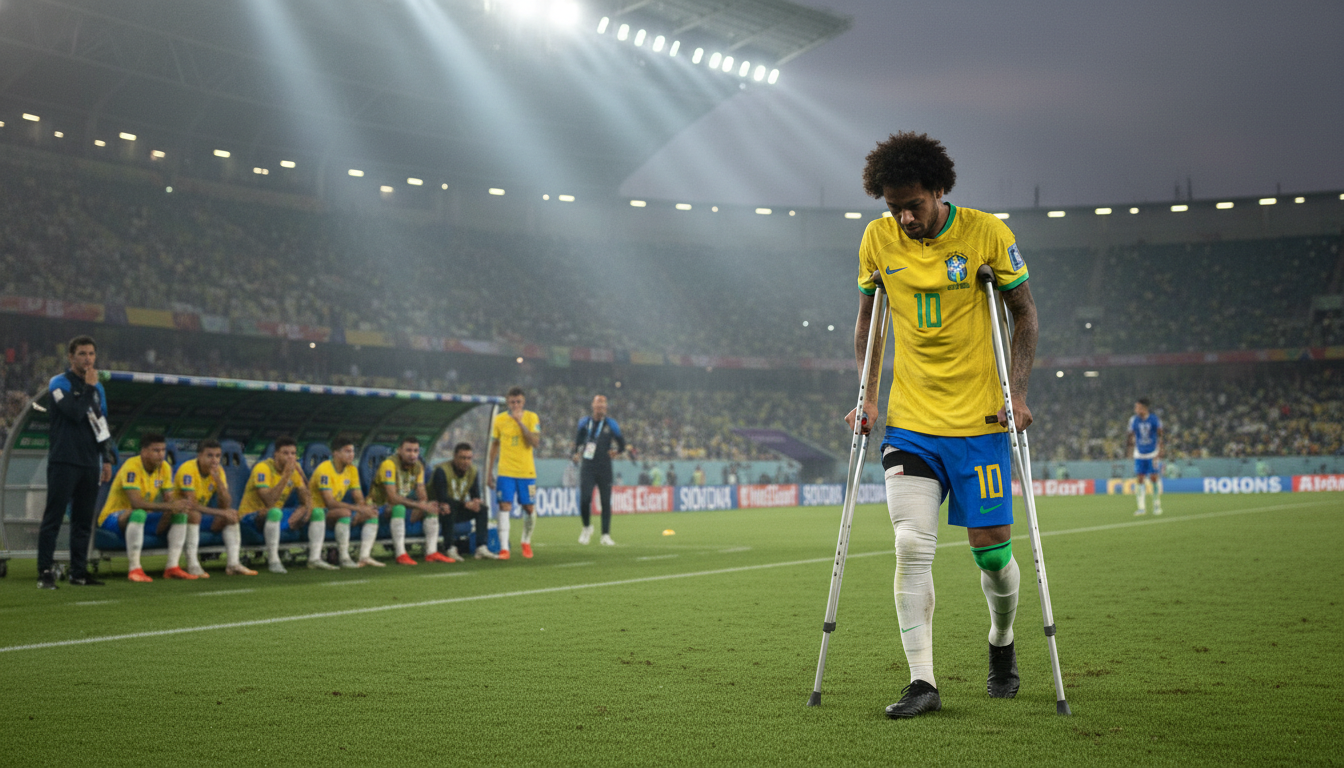
Brazil go to the 2026 World Cup without one of their most reliable goal contributors. Rodrygo Goes has been confirmed to have ruptured the anterior cruciate ligament and the lateral meniscus in his right knee. The injury, sustained in Real Madrid’s match against Real Betis in early April, is one that almost certainly rules him out of the tournament regardless of the surgical timeline. ACL ruptures with concomitant meniscal tears typically require eight to nine months of rehabilitation, with return-to-play sometimes pushed to 11 months for an elite winger whose game is built around acceleration and change of direction.
The 2026 World Cup runs 11 June to 19 July. Rodrygo’s surgery is scheduled for the first week of May. The math does not allow for any World Cup involvement. Brazil have lost him for the duration.
What Rodrygo had become for Brazil
Rodrygo’s role in the Brazil setup under Dorival Junior had evolved over the last two years. He started the 2024 Copa América as the inside-right forward in a 4-3-3, with Vinícius Júnior on the left and Endrick through the middle. By the time of the 2025 Copa América (in which Brazil reached the final, losing to Argentina), he had moved to a free-eight role on the right side of midfield, dropping in to combine with the No. 8 in midfield and overlapping the right back into the channel.
That tactical evolution mattered because it was the bridge between Brazil’s central midfield and Vinícius on the left. With Rodrygo connecting the wings and the midfield, Vinícius received the ball higher up the pitch, faster, and with more space. Without Rodrygo, the connecting work falls on either Raphinha (a different profile, more a winger than a connector) or Lucas Paquetá (more a central player). Neither replicates what Rodrygo gave the team.
The likely replacements: Estêvão, Raphinha and the Endrick question
Three players will absorb Rodrygo’s minutes:
- Estêvão Willian — the 19-year-old Chelsea-bound winger has been outscoring his expected goals at Palmeiras and was already a near-certain starter on the right. The Rodrygo absence accelerates that. Estêvão starts the tournament.
- Raphinha — reverts to the wider role he excels in at Barcelona, with more touches and more shots. The Barcelona version of Raphinha — 18 goals across the 2025–26 La Liga and Champions League seasons — is exactly the player Brazil need.
- Endrick — the 19-year-old Real Madrid striker was always going to be in the squad. The question now is whether he starts at the No. 9 or whether Dorival Junior rotates him with Vinícius into a fluid front three.
The most likely setup is a 4-3-3 with Estêvão right, Vinícius left and Endrick or João Pedro central. The structure works on paper. The question is whether the connecting play between midfield and the front three can be replicated without Rodrygo.
The market reaction
Brazil’s outright winner price drifted from +750 to +800 within 24 hours of the injury news. The 50-cent move is roughly proportional to a 0.5% reduction in implied probability, which is what the market typically prices for the loss of one starter who is replaceable from within the squad. Compare that to, say, what happened to Argentina’s price after Lionel Messi was briefly doubtful in March (+800 to +850 — a similar move) or what happened to France in late 2024 when Mbappé suffered a calf strain that was initially feared to be more serious (+550 to +650 — a bigger move because the replacement options were thinner).
The Brazil case at +800 still rests on three pillars. First, Vinícius Júnior remains arguably the best left winger in the world, and the front three’s productivity will largely flow through him. Second, Estêvão is one of the highest-rated 19-year-olds at the tournament and will be playing without the burden of being the team’s main man — a setup that has historically suited young Brazilian wingers. Third, Brazil’s defensive setup under Dorival Junior is the most settled it has been since 2018, with Marquinhos and Éder Militão in the centre (Militão has been racing back from his own knee injury — confirmed fit as of mid-April) and Vanderson and Wendell at full-back.
Group C and the path to the round of 32
Brazil were drawn into Group C alongside Morocco, Haiti and Scotland. The opener — Brazil vs Morocco at MetLife Stadium on 13 June — is the most marquee group-stage matchday-1 fixture of the tournament, and it became a more interesting fixture the moment Rodrygo’s injury was confirmed. Morocco, with their disciplined 4-1-4-1, are precisely the kind of opponent that exploits a Brazil side that has lost its connecting midfielder. The match is a genuine 50/50 in current bookmaker markets — Brazil priced at -130 to win, draw at +280, Morocco at +320.
The other two matches — Haiti and Scotland — are matches Brazil are expected to win comfortably. Group C should still finish with Brazil first, Morocco second and Scotland third on six points. The risk is the Morocco match itself: lose that, and Brazil are second seed in the group with a likely round-of-32 against Spain, a fixture they are not favoured to win.
The Golden Boot board: a quiet adjustment
Rodrygo’s injury also moved the Golden Boot market, but only at the margins. Vinícius Júnior was at +2500 before the injury and has stayed at +2500 — the implied probability of 3.8% is unchanged because the market was already pricing him as Brazil’s primary scorer with Rodrygo as a complementary assist creator. Estêvão was at +5000 before the injury and has shortened to +3500 (implied 2.8%) — a move that reflects his probable starting role rather than any expectation of a Golden Boot run.
The bigger Golden Boot beneficiary is Raphinha, who has shortened from +6500 to +4500. Raphinha is the player most likely to inherit Rodrygo’s set-piece duties and his role as Brazil’s primary chance creator from open play. If Brazil go deep, he is now the second-most-likely Brazilian to win the Golden Boot — and at +4500 he represents the most generous Brazil-related Golden Boot price on the board.
The bigger picture: a brutal club season
Rodrygo joins a growing list of front-line players ruled out before the tournament even begins. Real Madrid alone have lost Rodrygo and Eder Militão (Militão has since returned, but only just). The Real Madrid injury list across the 2025–26 season has totalled 18 separate first-team injuries — the highest in their recorded history. Across Europe’s top five leagues, the 2025–26 season has produced the highest combined rate of major injuries (defined as four-week-plus absences) since 2014.
The reasons are well-rehearsed: a 32-team Club World Cup that consumed four weeks of summer 2025; an expanded Champions League with two extra group-stage matches; international windows in October and March that required transatlantic travel for South American players; and a 38-game domestic league season that ran almost without break. Modern footballers play more, recover less, and the injury rates are starting to reflect that.
FIFA’s decision not to expand squads to 30 looks harder to justify with each major injury before the tournament. The federations were right to ask. The explanation — operational complexity across 16 host cities — is real but not compelling against the backdrop of a season that has already broken records for player absences. The 2026 World Cup will be the first major tournament in which most contenders go to the finals with at least one star starter on the injury list. Brazil has lost Rodrygo. Real Madrid have lost others. Spain are nursing Yamal, Fabián and Merino. England will lose at least one regular before the squad is named. France are managing Mbappé. The injuries are not coincidental — they are the predictable outcome of the calendar.
The Rodrygo career arc, briefly
Rodrygo’s absence from this World Cup is also an absence from the tournament that should have been the first peak of his international career. He turned 25 in January and was, on most projections, entering the prime three-year window of his playing career. Real Madrid’s most reliable big-game scorer of the last three Champions League cycles — five goals in six knockout-round matches in 2023–24 alone — was the player Brazil had built their right-side attack around. The 2026 World Cup was supposed to be his coming-out tournament at the senior international level.
The recovery from a combined ACL and lateral meniscus rupture is a 9-to-11-month process. He will be available for Real Madrid’s pre-season in early August 2026 at the very earliest, and more realistically for the second half of the 2026–27 La Liga season. By the time he returns to international football, the next major tournament — the 2027 Copa América — will be eight months away. He will be 26.
The 2030 World Cup, when Rodrygo will be 29, is the next chance. By then, Brazil’s attacking generation will have shifted: Estêvão will be 24 and at peak; Endrick will be 23; Vinícius Júnior will be 30. Rodrygo will plausibly still be a starter but the team will be younger around him. The 2026 tournament will be the one that, in retrospect, will be marked as the year Brazil were missing him.
The Brazil case at +800, with Rodrygo out
Brazil at +800 implies an 11.1% chance of winning the tournament. That is, on a sober reading, slightly generous given the front-three reshuffle. Brazil’s defensive structure is solid, their midfield is competent, their goalkeeping is reliable, and their replacement attackers are talented. What they have lost is the specific tactical interlock that connected midfield to the front three. Without it, Brazil are still a top-five team — just no longer the top-five team that should be priced fourth on the board. A fairer price after the injury is +900 to +1000. The market has not fully adjusted, which is reasonable evidence that Brazil at +800 is now a slight overlay against the market — i.e. you should fade Brazil if you are looking for a contrarian pre-tournament hold.
The path to a Brazilian title still exists. Win Group C (which requires beating Morocco at MetLife or drawing and beating Scotland and Haiti more comfortably than Morocco does); play one of Switzerland, Qatar or Bosnia in the round of 32; play England, Spain or Belgium in the round of 16; play one of France, Argentina or Portugal in the quarters. Six matches, four of which are projected even-money or worse against Brazil. The expected value of each match is roughly 50–60%. Compound those probabilities and you arrive at roughly an 8–10% likelihood of lifting the trophy. The +800 price is not far off, but it is no longer the obvious value it once was.
Sources
Related news
17 Days Out: The 2026 World Cup Squad Announcement Week Is Complete
Brazil, Switzerland, Germany, England and Spain have all submitted their final 26. Argentina's cut lands 2…
Manuel Neuer’s Comeback at 40: Inside Germany’s Most Talked-About Goalkeeper Decision
Manuel Neuer has come out of international retirement to be Germany's No. 1 at the 2026…
Lennart Karl Makes Germany’s 26: Bayern’s Teenage Attacker Earns His World Cup Call
Lennart Karl, Bayern Munich's teenage attacking midfielder, has made Julian Nagelsmann's final Germany 26. Alongside Cologne's…