Squad Deadlines, Roster Rules and the New 27-Man Technical Staff Allowance for the 2026 World Cup
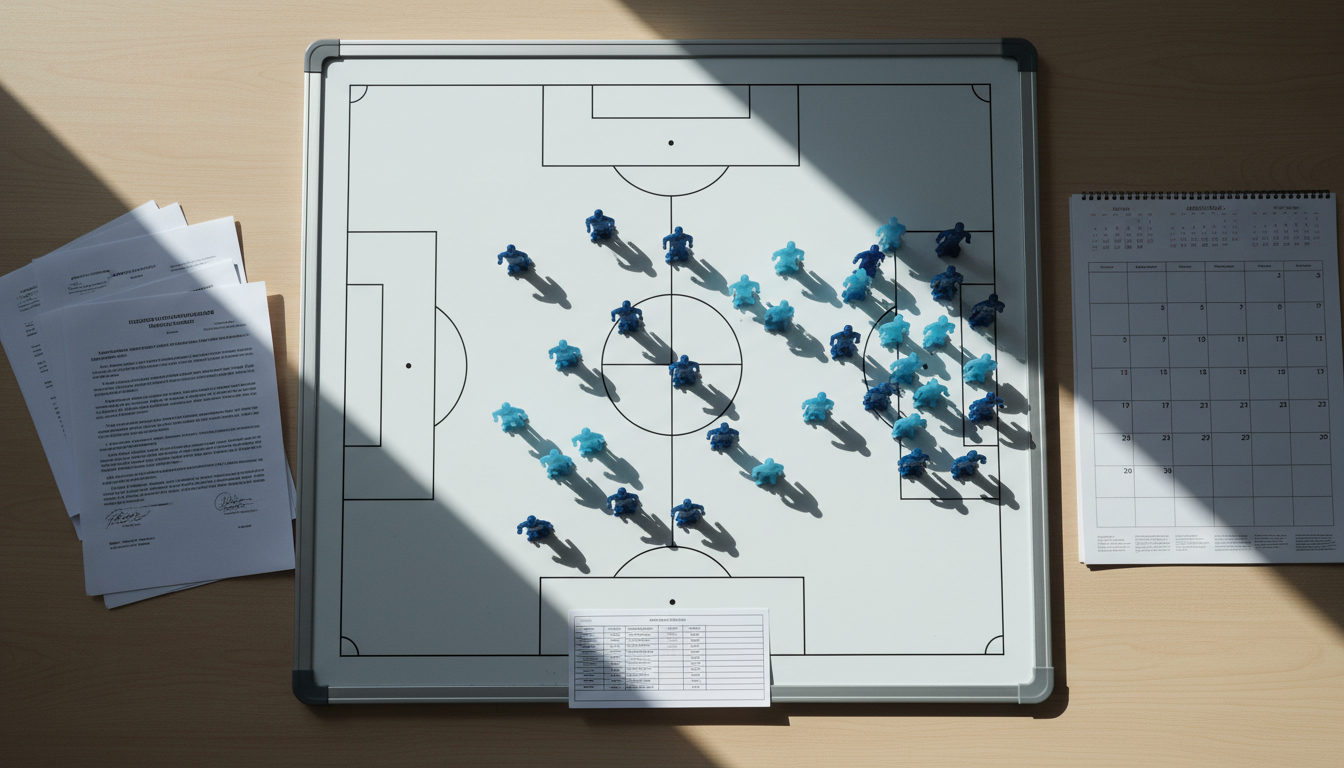
FIFA has confirmed the squad regulations for the 2026 World Cup, and the rules are in most respects identical to those used at Qatar 2022. Each of the 48 nations may register a final roster of between 23 and 26 players, with at least three goalkeepers required. The provisional squad — submitted before the final list — must contain between 35 and 55 players. The deadlines are 11 May 2026 for the provisional submission, 30 May 2026 for the final roster, and 24 hours before kick-off of a team’s first match for any in-tournament injury replacement, which must be drawn from the provisional list.
What stays the same as Qatar 2022
The 26-man cap stays. The three-goalkeeper minimum stays. The injury-replacement window stays at 24 hours before the first match. The rule that an injury replacement must come from the provisional list stays. The rule that, once registered, a player can only be replaced for injury (not form, not selection) stays. None of this is new and none of it should surprise the federations. What is new is the surrounding context.
What is new: the 27-man technical staff allowance
The first big change for 2026 is the technical-staff allowance. Each squad can now register up to 27 additional technical staff members, formally accredited and on-site for every match. That is a substantial increase on the 17–22 staff members typically registered at Qatar 2022, and it represents FIFA’s recognition that the way teams are coached has changed. Modern national-team setups now run with their own analysts, set-piece coaches, performance staff, sports psychologists, GPS data scientists and — increasingly — dedicated dietitians and chefs. The 27-staff cap is intended to allow federations to bring their full operational footprint to a tournament that runs 39 days for the finalists.
The practical implication is that the gap between the best-resourced and the least-resourced squads will widen at this tournament. France, England, Germany, Brazil, Argentina and Spain will register the full 27 — they already have that infrastructure at home and were limited in Qatar by the 22-staff cap. Smaller federations may register 12 to 18 staff. The cumulative effect across a tournament — recovery quality, tactical preparation, set-piece work — is meaningful, and it is one of the silent reasons the top-tier teams price as short as they do.
What is new: the 16-host-city operational profile
The second major change is geographic. Qatar 2022 was the most concentrated tournament in modern history — every match was within a 75-kilometre radius. The 2026 tournament is the most dispersed: 16 host cities across three nations, three time zones, two languages and a 5,000-kilometre east-west spread. The squad regulations remain the same, but the operational reality of running a 26-man squad across three weeks of group stage matches in (for example) Atlanta, Miami, then Atlanta again, is fundamentally different from doing it within Doha.
FIFA has tried to mitigate the dispersal problem with the geographic seeding model: each team’s three group-stage matches are scheduled within a regional cluster (East, Central or West) so that travel between matches is bounded at roughly 800 miles. But the round of 32 is the first knockout match, and from that point a team may be flown anywhere from Vancouver to Mexico City. The teams that handle the logistics best — and the technical staff with travel and recovery expertise — will hold an advantage that did not exist in Qatar.
What FIFA quietly declined to change
Federations had pushed for an expansion to 30-man squads, citing two arguments. First, the 2025–26 club calendar has been the most punishing on record, with the new 32-team Club World Cup adding a four-week summer tournament before the World Cup year. Second, the longer 39-day finalist window means a 26-man squad is more likely to suffer cumulative injuries than at any prior tournament. Both arguments were made formally to FIFA’s technical committee in February.
FIFA declined the proposal. The official reasoning was “competitive parity” — a vague answer. The substantive reason, as conveyed privately to federations, was operational: with 16 host cities, expanding squads to 30 would require an additional 192 hotel rooms and accreditations across the tournament, a 15% increase in the broadcast and accreditation footprint. The decision was therefore as much logistical as competitive. Federations were unhappy but accepted the ruling.
Why the provisional 35-man list is the document to watch
The provisional 35-man list is published on 11 May. It tells you four things that the final 26-man list does not. First, who the manager is keeping in reserve as injury cover — these are the borderline players who would be in the squad if a regular starter went down. Second, who is being protected from late-season club fatigue — players who are on the provisional list but expected to be cut from the final 26 are sometimes simply being given a rest. Third, which fringe positions are weak — if a manager names six full-backs on the 35-man list, it is because he does not trust two of his three to start. Fourth, the manager’s tactical leanings — the ratio of central midfielders to attackers tells you about the system he intends to play.
For the betting markets, the provisional list is the bigger price-mover than the final 26. Outright odds, group-winner odds and Golden Boot odds all see meaningful volatility in the second week of May. The final 26-man list moves prices less because it largely confirms what the provisional list already implied.
Tactical implications of the 26-cap
A 26-man squad with three goalkeepers leaves 23 outfield players. The tactical convention is now broadly four full-backs, six centre-backs, six central midfielders, three or four wingers and three or four strikers. The teams that deviate are the ones with strong identities — Spain typically take an extra central midfielder; Brazil typically take an extra winger; Germany under Nagelsmann has shown a preference for hybrid wing-back/centre-back profiles that compress the count.
The 26-cap is also why the game has become so dependent on multi-position players. The most-valued profile in modern international football is a defender who can play full-back and centre-back, or a midfielder who can play No. 6 and No. 8. Players who can only play one position are being squeezed out of squads, and that trend will accelerate at this tournament.
Injury-replacement rules: the most important fine print
If a registered player suffers an injury before the team’s first match, he can be replaced — but only from the provisional 35-man list. After the team’s first match, replacements are no longer permitted, with one exception: a goalkeeper can be replaced at any point in the tournament if he suffers a tournament-ending injury. The asymmetry is intentional — losing a starting goalkeeper is uniquely catastrophic, since it is the one position no other player on the squad can plausibly cover.
Federations have lobbied for a more permissive replacement rule for outfield players, particularly given the longer tournament. FIFA has held the line. The result is that the first match takes on outsized importance: if a key player goes down at half-time of the opener, the squad must absorb that loss for the duration of the tournament.
What the federations are doing in the second week of May
Every federation will be running its medical pre-tournament check in the first week of May. Every federation will be deciding whether to take a borderline-fit player as an injury bet, or to leave him out and call up a fully-fit alternative. Every federation will be holding pre-camp medical and psychological screenings in the second and third week of May. The tactical work — the actual training sessions in which the manager builds the team that will play the opener — runs across three weeks at the team base, typically in the host country and at modest altitude or in a similar climate to the matches the team will play.
The teams that get this preparation right have historically over-performed at major tournaments. The teams that get it wrong have under-performed. The squad rules do not change much across cycles, but how a squad is assembled around the rules makes a real difference — and the 2026 World Cup, with its 16-city footprint, will be the most operationally complex tournament ever held. The rule book is small. The execution is everything.
Squad announcement timeline: a working calendar for fans and bettors
Between now and 11 June, the federation calendars will run as follows. The first two weeks of May will see club seasons end across Europe; English Premier League finishes 24 May, La Liga 24 May, Bundesliga 16 May, Serie A 24 May, Ligue 1 17 May. Champions League final is 30 May in Munich. The window in which players join their national teams therefore runs from roughly 25 May to 1 June for most contenders, with players involved in the Champions League final joining as late as 1 June.
Provisional 35-man squads land on 11 May, eight days before most domestic seasons end. That is intentional — federations need the long list before knowing whether their key players are healthy at season end, so the provisional list always reads as conservative. The final 26-man cut is on 30 May, by which point club seasons are over and the medical picture is clear.
Pre-tournament friendlies are scheduled across the first week of June. Most contenders will play one or two warm-ups against tier-two opposition. France play their warm-ups against Cameroon and one TBC opponent in the first week of June. England play Senegal and Andorra. Spain play Switzerland and Tunisia. Brazil play Senegal and one TBC. Argentina play Honduras and one CONMEBOL opponent. The friendlies are not predictive in themselves but they are the last test before the opening-match team is locked in.
What the rules don’t capture: the human element
Squad selection is a numbers game on paper but a human game in practice. Every cycle produces stories of players who were left out and went on to define their careers, and stories of players who were picked over more deserving alternatives because of dressing-room dynamics. The 2026 cycle will have its own version of that. Watch for marginal calls in the centre-back and No. 8 positions on the contender squads — those are the picks that look intuitive on the announcement day and turn out to define the tournament for the team that gets them right.
The 2026 World Cup is, in administrative terms, the largest, most complex, most geographically spread tournament FIFA has ever organised. The squad rules are the same as Qatar. The execution will not be. That gap — between the small print and the operational reality — is where teams will be made and broken between 11 May and 11 June.
Sources
Related news
17 Days Out: The 2026 World Cup Squad Announcement Week Is Complete
Brazil, Switzerland, Germany, England and Spain have all submitted their final 26. Argentina's cut lands 2…
Manuel Neuer’s Comeback at 40: Inside Germany’s Most Talked-About Goalkeeper Decision
Manuel Neuer has come out of international retirement to be Germany's No. 1 at the 2026…
Lennart Karl Makes Germany’s 26: Bayern’s Teenage Attacker Earns His World Cup Call
Lennart Karl, Bayern Munich's teenage attacking midfielder, has made Julian Nagelsmann's final Germany 26. Alongside Cologne's…